
Sermon
A Storm, a Cry for Help, and the Son of God
Sunday, August 9, 2026
The Rev. Lucia Lloyd
Share This Sermon
Scripture Reading
Select the Bible reference below to read the passage without leaving the sermon.
“Immediately” is the way today’s gospel passage begins. In Matthew’s gospel, which we are reading this year, the word “immediately” appears 18 times, and 3 of those 18 times are right here in today’s passage.
“Immediately Jesus made the disciples get into the boat and go”. What’s going on here? We are picking up right where we left off with last Sunday’s gospel reading. You will remember from last Sunday’s sermon that when Jesus heard how Herod had killed John the Baptist, he wanted some alone time with God, so much so that he fled from the crowds by taking a boat to a deserted place by himself. However, when he gets there, he discovers that the crowds have travelled on foot all the way around the sea to be with him and are now surrounding him again. He has compassion on them, and so he makes some sacrifices to spend all day with the crowd, curing their sick. As evening falls, and the disciples urge him to dismiss the crowd to go into the villages and buy food for themselves, he instead takes the two fish and five loaves and feeds the multitude. Two things are worth paying attention to. First, it is a beautiful thing to see the way Jesus has compassion for the crowd, and the way Jesus sets aside his own physical, emotional, and spiritual needs in order to care for the needs of other people. Second, it is a beautiful thing to see the way Jesus knows when it is time to stop ministering to others and take time alone with God for prayer. So immediately Jesus makes the disciples get into the boat (the Greek word is more like compels them to get into the boat) and go on to the other side. Jesus then dismisses the crowds, and heads up the mountain by himself to pray. Jesus postpones his own need for time alone with God in prayer for a while to minister to others, but he does not make the mistake of postponing it too long. Whether or not he’s gotten to every single sick person in the multitude, he knows when it’s time to stop caring for others and return to his own spiritual needs.
It is a reminder to us that there are some times when it is the right thing to do to set aside your own physical, emotional, and spiritual needs in order to care for the needs of other people. It is also a reminder of the importance of not letting that go on too long; it is important to stop, and tend to your own physical, emotional, and spiritual needs, before you’re stretched to the breaking point. When we think we are too busy to pray is often when we need prayer the most. Jesus was smart enough to know that he needed alone time with God, and smart enough to immediately send everyone away to get it.
Jesus does get his alone time with God in prayer, and is renewed for the challenges ahead. In the meantime, the disciples’ boat is being battered and tormented by the waves, far from land, as the wind is against them. The disciples know how dangerous it is to be in a small boat in the middle of a storm at sea. But then they are even more terrified: they see someone walking toward them on the sea—a ghost! They cry out in fear! We can see why. They have in their brains the category of ordinary people, and they have in their brains the category of ghosts, who can do things ordinary people can’t do. Since someone walking on water doesn’t fit into the ordinary people category, he must be in the ghost category. It is a logical, rational deduction. Except it happens to be wrong. When they are limited to the old categories their rational brains have constructed, they don’t recognize what is right in front of them: Jesus.
This is the problem that we often bump into in our doubts and questions. We are used to thinking within the old categories that our rational brains have constructed. , and assuming anything that doesn’t make sense within those categories doesn’t make sense at all. Jesus is operating outside of the limitations of our old categories. If we continue to limit our understanding and our faith to what’s inside the categories, we will also not recognize Jesus when he is right in front of us, and we will not recognize God, or the Holy Spirit, or any form of divine presence that isn’t limited to our old categories. We will not recognize miracles or angels or various forms of the kingdom of heaven.
Jesus immediately responds to the disciples, in the second “immediately” of this passage.
Jesus addresses their fear and says, “Take heart”, then he tells them what’s right in front of them. He says, “It is I.” Or, if you’re not a stickler for a rule of English grammar which is becoming more obsolete all the time, “It’s me.” Or, you could translate the Greek as Jesus simply saying “I am”. That may remind us of what happens when God speaks to Moses from the burning bush and Moses asks God’s name. When God gives God’s name, it is often translated “I am” but can also be translated “I am who I am” or “I will be who I will be” or “I cause to be what I cause to be”. Another example of God’s existence beyond the limitations of our rational categories. Then Jesus tells them directly, “Do not be afraid.”
Jesus addresses both their fear and their misunderstanding. “Take heart” addresses their fear. It’s a way of saying “take courage”. He then addresses their misunderstanding. “It’s me, Jesus. I’m not a ghost.” Then he returns to addressing their fear, saying directly, “Do not be afraid.” What strikes me most in today’s passage is the way Jesus reveals how deeply intertwined fear is with doubt and misunderstanding. We normally think of fear as something emotional, and doubt or misunderstanding as something mental, logical, cognitive. However, there is something frightening about things we don’t understand, there’s something frightening about not knowing what’s going on, not knowing what to do, not being in control. Since feeling frightened is so uncomfortable, we sometimes revert to trying to get rid of the fear by denying that something mysterious is happening, or trying to force it into one of the old categories, or trying to subject it to rigorous analysis. The problem is that doing any of those things can get in the way of seeing what’s actually happening. Jesus is walking on water. So he tells them how to handle their fear: take heart. He tells them what’s actually happening: “It’s me.” He acknowledges their fear and tells them to let go of it: “Do not be afraid.”
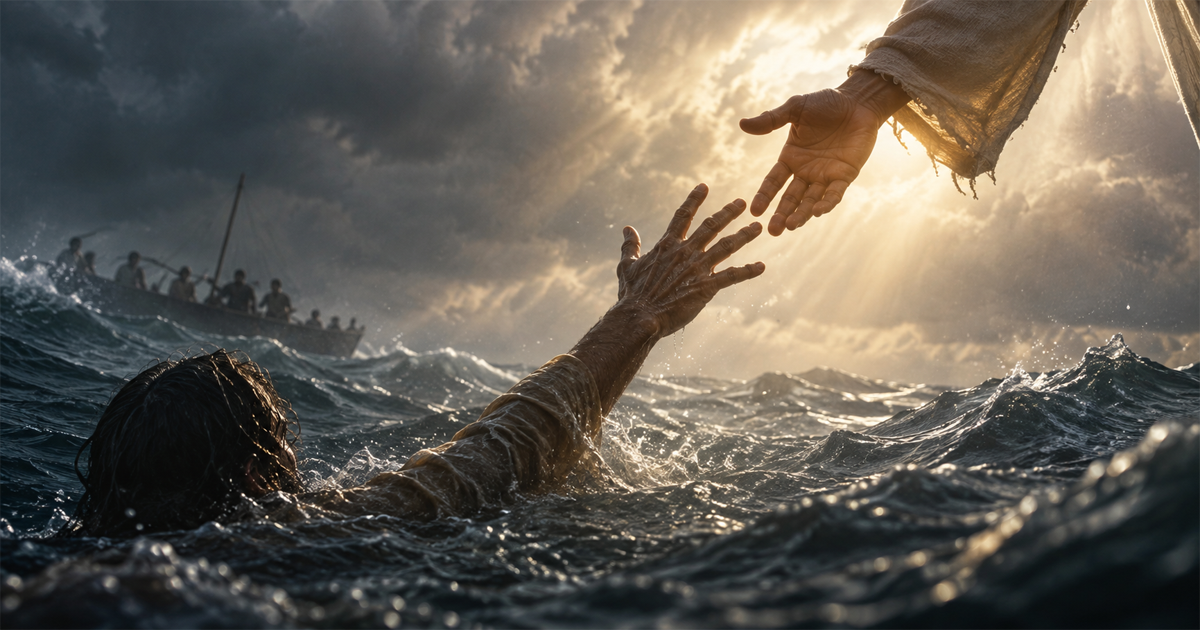
Peter takes this message to heart and says, “Lord, if it is you, command me to come to you on the water.” I love the way Jesus replies by simply saying, “Come!” And Peter steps out in faith, and starts walking on the water toward Jesus. It is amazing! And then Peter notices the strong wind, and becomes frightened. As he is beginning to sink, Peter cries out. The word “cried out” here is the same as the word as when the disciples cried out in fear. There is one difference. Instead of just a crying out in fear, Peter cries out to Jesus, “Lord, save me!” It is a very moving verse. Like Peter, we have times when we can and do step out in faith, and other times when we get distracted by our fears. Like Peter, we find it impossible to keep our eyes on Jesus 100% of the time. Like Peter, we cannot save ourselves by the strength of our own faith. And in this moment, Peter does exactly the right thing. He cries out to Jesus, “Lord, save me!” and Jesus does. In the third “immediately” of this passage, Jesus immediately reached out his hand and caught him, saying to him, “You of little faith, why did you doubt?” I see that as a genuine question for Peter to reflect on. The word for doubt here is not the same as “disbelief” or “unbelief”, it’s a word that means “wavering” or “vacillating”. Peter had the experience of believing in Jesus, even the experience of walking on the water. So why did he doubt? When he noticed the strong wind, he became frightened.
It is often the same for us. We have the experience of believing in Jesus, even the experience of things that come from God, but when we notice what’s going on around us, we become frightened. Our fears generate questions: Is this real? Can this continue? Am I sure about this? Am I safe? These may seem to us like mental, logical, cognitive questions, but they are generated by the emotion of our fear. Sometimes the faith that used to be solid isn’t solid anymore, and we begin to sink. It is at that point that we can cry out to Jesus, “Lord, save me!” Because the good news for all of us who have weaknesses is that we don’t have to save ourselves. The good news of the gospel is that it is Jesus who saves us. It is the Jesus who operates beyond the familiar categories we understand. It is the Jesus who cares about us when we have great faith and when we have little faith. It is the Jesus who cares about us when we believe and when we doubt. It is the Jesus who helps us when we cry out for help.
When Jesus and Peter get into the boat, the wind ceases. And now the disciples can see that Jesus is someone who doesn’t fit into the category of ordinary people, and doesn’t fit into the category of ghosts. They recognize who Jesus really is, and worship him, saying, “Truly you are the Son of God.” Jesus walking on water is miraculous, and Peter walking on water is miraculous. The importance of these miracles is that they reveal to us who truly saves us, and who to cry out to when we falter, or when we are sinking. The importance of these miracles is that they reveal to us that Jesus is truly the Son of God.