
Sermon
Epiphany 4, Year A
Sunday, February 1, 2026
The Rev. Lucia Lloyd
Share This Sermon
Scripture Reading
Select the Bible reference below to read the passage without leaving the sermon.
It can be easy to view the Sermon on the Mount as pure exhortation, writes Lutheran pastor Nadia Bolz-Weber in her book Accidental Saints. [Her sermon is also available online at
https://www.patheos.com/blogs/nadiabolzweber/2014/11/some-modern-beatitudes-a-sermon-for-all-saints-sunday/ and I have quoted from both the book version and the online version]
In her sermon on today’s passage, she says, “It can be easy to view the beatitudes – the “blessed ares” we just heard – as Jesus’ command for us to try real hard to be meeker, poorer and mourn-ier in order that we might be blessed in the eyes of God.”
But she looks at this passage from another angle and askes the question:
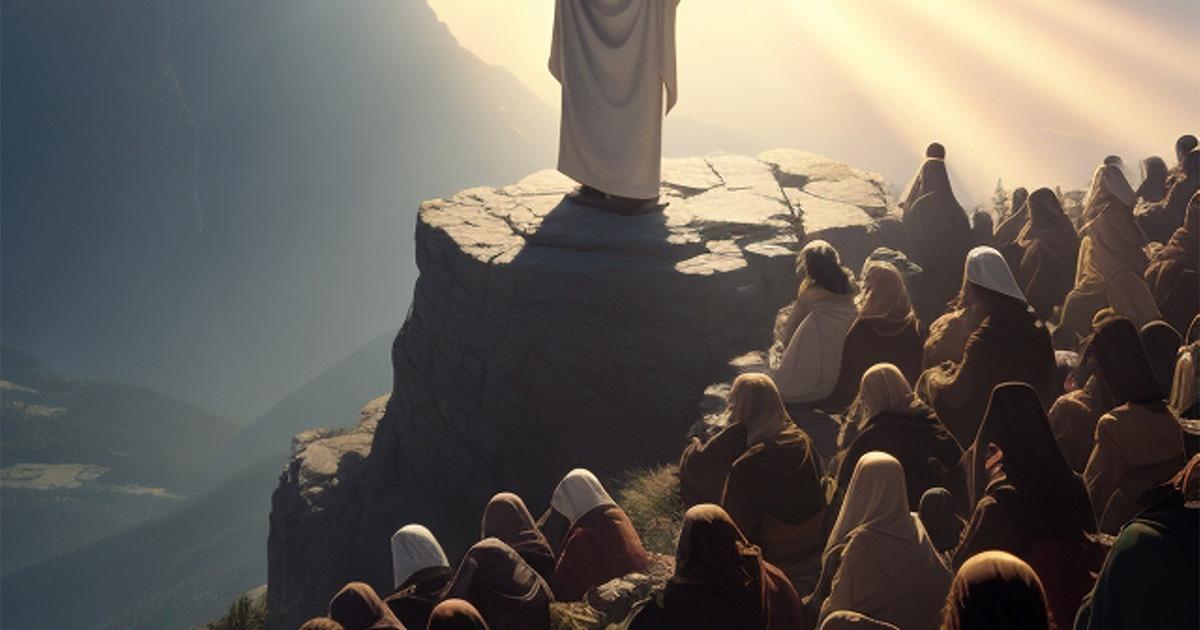
“What if the beatitudes aren’t about a list of conditions we should try and meet to be blessed. What if these are not virtues we should aspire to? What if Jesus saying ‘blessed are the meek’ is not instructive but performative?--meaning the pronouncement of blessing is actually what confers the blessing itself. Maybe the Sermon on the Mount is all about Jesus’ lavish blessing of the people around him on that hillside, blessing the people that their world—like ours--didn’t seem to have much time for, people in pain, people who work for peace instead of profit, people who exercise mercy instead of vengeance.”
“Maybe Jesus was simply blessing the ones around him that day who didn’t otherwise receive blessing, who had come to believe that, for them, blessings would never be in the cards. I mean, come on, doesn’t that just sound like something Jesus would do? Extravagantly throwing around blessings as though they grew on trees?”
So she imagines Jesus standing among us offering some new beatitudes, and she says to her congregation:
“Blessed are the agnostics.
Blessed are they who doubt. Those who aren’t sure, who can still be surprised.
Blessed are they who are spiritually impoverished and therefore not so certain about everything that they no longer take in new information.
Blessed are those who have nothing to offer.
Blessed are they for whom nothing seems to be working.
Blessed are the pre-schoolers who cut in line at communion.
Blessed are the poor in spirit. You are of heaven and Jesus blesses you
Blessed are they for whom death is not an abstraction.
Blessed are they who have buried their loved ones, for whom tears could fill an ocean.
Blessed are they who have loved enough to know what loss feels like.
Blessed are the mothers of the miscarried.
Blessed are they who don’t have the luxury of taking things for granted anymore.
Blessed are they who can’t fall apart because they have to keep it together for everyone else. Blessed are the motherless, the alone, the ones from whom so much has been taken. Blessed are those who “still aren’t over it yet.”
Blessed are those who mourn. You are of heaven and Jesus blesses you.
Blessed are those who no one else notices. The kids who sit alone at middle-school lunch tables. The laundry guys at the hospital. The sex-workers and the night-shift street sweepers.
Blessed are the losers and the babies and the parts of ourselves that are so small, the parts of ourselves that don’t want to make eye contact with a world that only loves the winners.
Blessed are the forgotten.
Blessed are the closeted.
Blessed are the unemployed, the unimpressive, the underrepresented.
Blessed are the teens who have to figure out ways to hide the new cuts on their arms.
Blessed are the meek. You are of heaven and Jesus blesses you.
Blessed are the wrongly accused, the ones who never catch a break, the ones for whom life is hard, for Jesus chose to surround himself with people like them.
Blessed are those without documentation.
Blessed are the ones without lobbyists.
Blessed are foster kids and trophy kids and special ed kids and every other kid who just wants to feel safe and loved.
Blessed are those who hunger and thirst for righteousness.
Blessed are they who know there has to be more than this. Because they are right.
Blessed are those who make terrible business decisions for the sake of people.
Blessed are the burnt-out social workers and the over-worked teachers and the pro-bono case takers.
Blessed are the kids who step between the bullies and the weak.
Blessed are the ones who have received such real grace that they are no longer in the position of ever deciding who the “deserving poor” are.
Blessed are they who hear that they have been forgiven.
Blessed is everyone who has ever forgiven me when I didn’t deserve it.
Blessed are the merciful for they totally get it.
She says, “I imagined Jesus standing there blessing us all because I believe that is our Lord’s nature. Because after all, it was Jesus who had all the powers of the universe at his disposal but who did not consider his equality with God as something to be exploited. Instead, he came to us in the most vulnerable of ways – as a powerless, flesh and blood newborn. As if to say, ‘you may hate your bodies, but I am blessing all human flesh. You may admire strength and might, but I am blessing all human weakness. You may seek power, but I am blessing all human vulnerability.’ This Jesus whom we follow cried at the tomb of his friend, and turned the other cheek and forgave those who hung him on a cross. He was God’s Beatitude – God’s blessing to the weak in a world that only admires the strong.”
She goes on, “So if you are here mourning, or feeling forsaken, abused, unseen, or no-longer-useful. If you, perhaps like myself, are all too aware that it is not your strength and virtue that qualify you to be called a saint, but your need for a God who makes beautiful things out of dust, then this meal we are about to eat is for you. It is as much for we who believe we have no need for it, as it is for we who believe we are not worthy of it. And know that it is not your ability to do for yourself, but your hunger that qualifies you to be fed. For it is a beatitude meal: the broken, blessed and given body of Christ. So as you come, behold who you are. And as the blessings Jesus pronounced on the mount so long ago – know that it is here that you become what you receive.”
I love her approach. Plenty of other people love it too, so much so that they requested that it be used as the blessing at every worship service she led wherever she went. The reason I love it is that it really does sound like Jesus. Jesus’ interactions with those who were hurting, especially those hurting from the ways they were ignored, disregarded, or abused by the rest of society, was not just to treat them with compassion. I get the sense that Jesus really saw each of them, with whatever weakness or pain or fear was in them, and that his response to seeing them was to bless them.
Striving to be a better person and a better Christian is valuable, don’t get me wrong. But it is not the only element of following Jesus. When we fail at being a better person and we fail at being a better Christian, it helps to remember that Jesus sees us, with all our failures, and blesses us. Jesus sees each of us, with whatever weakness or pain or fear is in us, and Jesus blesses us.
I also love the way her sermon takes me beyond myself and gives me the chance to imagine what it would be like to look at other people through the eyes of Jesus, as Jesus looks at each person who is spiritually impoverished, each mother of the miscarried, each sex worker and each night-shift street sweeper, each person without documentation, each burnt-out social worker, and says blessed are you.
In a world with so much pain, injustice, fear, hopelessness, and violence, I believe our crucified Christ still looks at each suffering person and blesses each one. And he makes me want to see each suffering person through the eyes of Christ, and to see how blessed they are. Blessed are you. Blessed is each hurting person around you.