
Sermon
Pentecost Sunday
Sunday, May 24, 2026
The Reverend Lucia Lloyd
Share This Sermon
Scripture Reading
Select the Bible reference below to read the passage without leaving the sermon.
“Vive la difference!” say those who speak French. It is a wonderful message, and a wonderful expression of it. “Vive” itself is a word that is so, well, vivacious. There’s a lot more to it than the English word “live” and there isn’t really an English equivalent of “vive.” In fact, when you think about “Vive la difference!” you have the opportunity to celebrate that the difference between French and English is that there are things you can’t really say in English that you can say in French, such as “vive la difference”. The difference in the opportunities the language provides is itself a difference worth exclaiming “vive la difference!” Go figure.
The reverse is also true. To say, “go figure” is easily done in English, but you just can’t say “go figure” in French.
Now we’re going to switch gears for a moment. Close your eyes and imagine a timeline with three dates on it: 1687 Isaac Newton formulates the law of gravity, 1867 Canadian Confederation, and 1969 the first people landing on the moon. Once you have a mental picture of that timeline, open your eyes. I’d always taken the notion of timelines for granted until I read Daniel Gilbert’s excellent book Stumbling on Happiness in which he points out that the reason we think of time as a line from left to right is that the language we speak is English. If we were native speakers of Arabic or Hebrew, our timelines would go from right to left, and if we were native speakers of Mandarin, our timeline would be vertical. Go figure.
Each of us assumes that we are experiencing reality as it is. But when we look more closely, we discover that our experience of reality is not universal, it is shaped by our native language. The ways in which we interact with the world around us are shaped by our native language also, because our language determines which things we can and cannot express and how we express them. No human language has words to express every aspect of human experience; no language is perfect. Still, language is the primary way in which human beings describe to each other our thoughts and feelings, our memories, our hopes, and our experience of something as central as love. Language is not perfect, but it is immensely valuable.
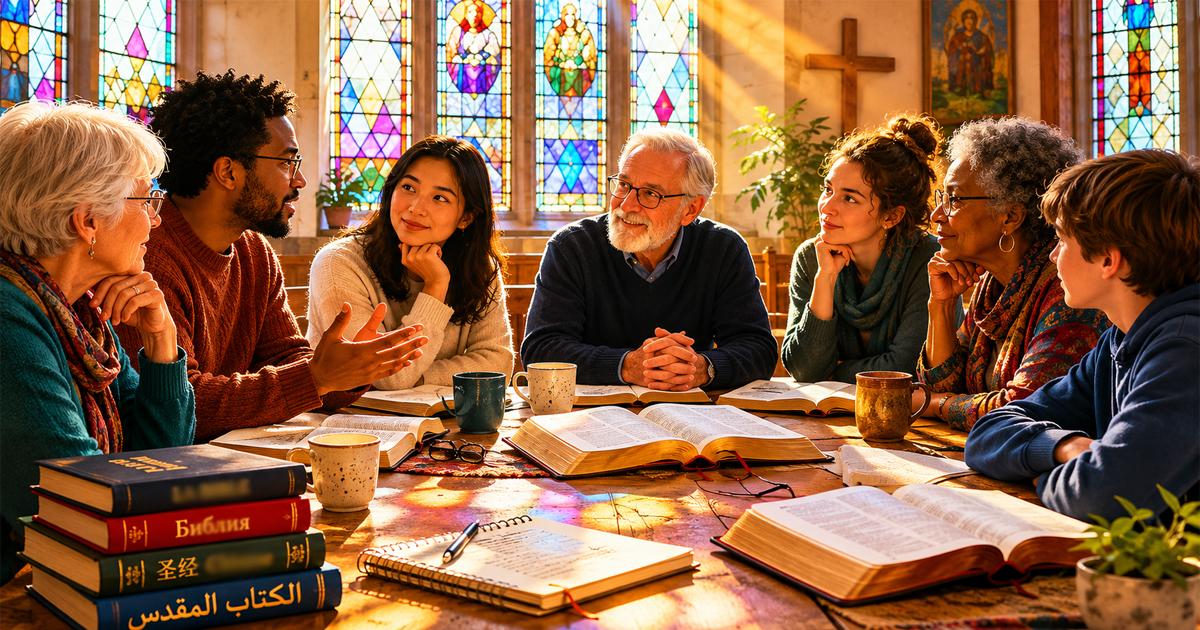
Today’s reading from Acts describes the Holy Spirit enabling each of the listeners from various parts of the globe to hear the gospel in his or her own language. What that involves is that each listener is getting a somewhat different experience of God because their experience of God comes through different languages. We tend to think of God as Universal Truth, and that’s good. God is perfect. Still, no one person’s experience of God is perfect or complete, because it is shaped by the language we speak, the century we live in, the gender we inhabit, the life we’ve lived so far.
One of the valuable lessons I learned when I was an assistant priest in my first parish was from June Hardy Dorsey, who led most of the Christian Education there. Even when she was talking to the children, June did not fall into the habit of using the phrase, “the Bible says….”; instead, she would tell the kids, “the Gospel of Matthew says….” Or “psalm 127 says…” or “Jesus says….” or “the Apostle Paul says”. It is a way of conveying that the Bible is not a monolithic entity with a single point of view. Instead, the Bible is a collection of 66 different books in which a plethora of different voices speak of their experiences of God, at different times and places, in different languages and with different perspectives. Some fundamentalists claim that there is only one interpretation of scripture, but scripture itself is so boldly un-fundamentalist that it includes four different gospels side by side. There are two different creation narratives in Genesis, and the compilers of the scriptures did not insist on narrowing them down to one. Instead of insisting that one was “right” and the other was “wrong” they chose the very un-fundamentalist option of keeping both narratives side by side, and kept maintaining that inclusion of both over the course of countless generations in century after century after century, so we still have the benefit of both today.
The celebration of Pentecost reminds us that what really matters is not just the message itself; what truly matters is the way the Holy Spirit transforms our lives by enabling each of us to experience the good news in our own language, with all the differences that involves. It is hard to pin down how we would define what it means to say that scripture is “the Word of God.” In the Anglican Church, priests sign a statement affirming that scripture “contains all things necessary for salvation.” It is a significant difference: instead of trying to state what scripture is, we talk about what scripture does. Instead of focusing on a book, we focus on the Spirit that uses that book to set in motion our salvation, by the grace of God. It is the Holy Spirit that makes the words of scripture speak to each of us today in our own life circumstances, in our own language.
There are people who find it preposterous to say that a book is “inspired by God,” especially a book that has human fingerprints all over it. All the flaws of humanity are visible in various places in the Bible: violence, smugness, sexism, nationalism, hypocrisy, and various forms of wackiness. “Isn’t it just another book?” people ask.
I have always loved literature and have learned plenty from it. I enjoyed being an English teacher. But when I do a close reading of a scripture passage, it challenges me and changes me in a way that a close reading of The Great Gatsby simply doesn’t. When I do a close reading of a scripture passage, it challenges me and changes me in a way that a close reading of Aesop’s Fables simply doesn’t. It puts me in touch with transcendent mystery and love. It gives me hope. It enables me to see the holiness and wonder of existence. It explodes my preconceived notions and ignites fresh insights. And when I read and talk to others whose lives have been enriched by scripture and whose faith has been strengthened by it, I can see that their experience has come not from themselves, not from the book, but by the inspiration of something beyond both the person and the book, and that it has been speaking in the person’s own language. I can see the other person’s flaws and blind spots, and yet I can see the Holy Spirit at work in them. And it occurs to me that other people can see my flaws and blind spots, and can see that the Holy Spirit is at work in me. Go figure. So we’ll cherish the best in everyone’s experience of God, and celebrate the Holy Spirit’s work in multiple languages. Vive la difference!